
𝑎𝑓𝑎𝑐ℎ𝑟𝑦@𝑚𝑖𝑡𝑚𝑎𝑛𝑑.𝑜𝑟𝑔
NTB’s climate problem is not an abstract future threat. It is already visible in drought alerts, water stress, agricultural uncertainty, and coastal vulnerability. In August 2025, several NTB regencies entered drought alert status, including areas in Dompu, Bima, and East Lombok. By October 2025, provincial authorities were still maintaining drought alert status as clean-water stocks came under pressure from continuing public demand.
For NTB, drought is not merely a weather event. It is a social multiplier. When rainfall fails or water systems weaken, farmers lose planting certainty, livestock owners struggle with feed and water, households spend more time obtaining clean water, and poor families become more exposed to food insecurity. The burden often falls hardest on women and children, who are more likely to absorb the hidden labor of water scarcity.
BMKG’s NTB climate outlook for early 2026 showed rainfall variability, with May 2026 predicted to range from low to medium rainfall in many areas, with rainfall characteristics varying from below normal to above normal. This variability is itself a problem. Farmers and fishers can adapt to predictable seasons, but unstable seasons destroy inherited knowledge. The old agricultural calendar becomes less reliable. Planting decisions become more speculative. Risk moves from the sky into household income.
The province’s water issue is closely tied to food security, which the NTB government placed as one of its three strategic pillars for 2026. That connection is vital. Food security is not only about producing rice or maize; it is about water governance. Without reliable irrigation, watershed protection, groundwater management, climate information, and drought-resilient crops, food policy becomes fragile.
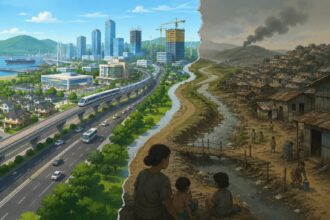
NTB’s geography makes the problem sharper. The province contains coastal settlements, dryland farming areas, small islands, hilly terrain, and river systems vulnerable to seasonal extremes. Climate change does not strike these places equally. Coastal communities face erosion, sea-level pressure, and storm exposure. Dryland farmers face crop failure. Urban areas face drainage and waste-linked flooding. Tourism zones face water competition between residents, hotels, restaurants, and visitors.
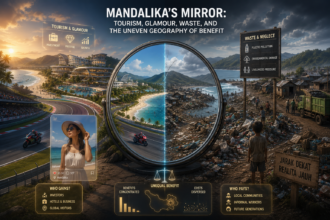
This is where climate policy becomes politically sensitive. In tourism areas, water is not just a natural resource; it becomes an economic battleground. When hotels, villas, restaurants, and tourism facilities expand, water demand rises. If local communities feel that tourism consumes water while they endure scarcity, resentment grows. Sustainable tourism in NTB cannot be reduced to slogans about beautiful beaches. It must include water justice.
There is also a disaster-governance dimension. Indonesia’s recent climate disasters have demonstrated that extreme rainfall, deforestation, and land-use damage can interact dangerously. National reporting after the catastrophic Sumatra floods in late 2025 highlighted the role of climate-intensified weather and environmental degradation in worsening disaster impacts. While that disaster occurred outside NTB, the lesson is highly relevant: climate risk becomes deadlier when ecosystems are weakened and planning is poor.
NTB needs to move from emergency response to climate anticipation. Sending water trucks during drought is necessary, but it is a symptom treatment. The deeper work involves watershed restoration, village-level water storage, climate-smart agriculture, drought-resistant seeds, irrigation efficiency, early-warning systems, and protecting catchment areas from destructive land conversion.
The province also needs better integration between scientific climate data and local decision-making. Forecasts are useful only if farmers, village heads, water-user associations, tourism operators, and district agencies understand and act on them. Climate adaptation must become a governance habit, not a project document.
The most urgent point is this: water scarcity can quietly undo progress in poverty reduction, health, tourism, and education. A child cannot study well if the household spends hours searching for water. A farmer cannot invest confidently if rainfall is uncertain. A tourism destination cannot remain attractive if water conflict and waste pollution grow. A province cannot claim resilience if its poorest villages experience every dry season as a recurring emergency.
NTB’s climate issue is fascinating because it reveals the invisible infrastructure of development. Roads, airports, and hotels are visible. Watersheds, aquifers, rainfall patterns, soil moisture, and village wells are less visible—but they decide whether development survives.